Technical consensus · iPhone
Fifty strategies vote. Only the ones that beat holding get counted.
Every night after the close, Muster runs fifty classic technical strategies over an asset's history and checks each one against buying that asset and sitting on it. A strategy that lost to sitting still gets no vote. What survives is counted, and you read one word per time horizon.



Free · iPhone · iOS 27 or later · No account, no email
One asset, example reading
7 buy4 hold17 sell
28 of 50 qualified
14 buy6 hold11 sell
31 of 50 qualified
26 buy3 hold5 sell
34 of 50 qualified
“Long term is buying what swing is selling.”
What the app actually does
A technical strategy is a rule someone wrote down decades ago, like “buy when the 50-day average crosses above the 200-day average.” There are hundreds of them, most investing apps show you a handful, and none of them tell you whether that rule ever worked on the stock you are looking at. RSI is decent on a stock that trends and it is noise on one that chops sideways, and a rating that averages both treats them the same.
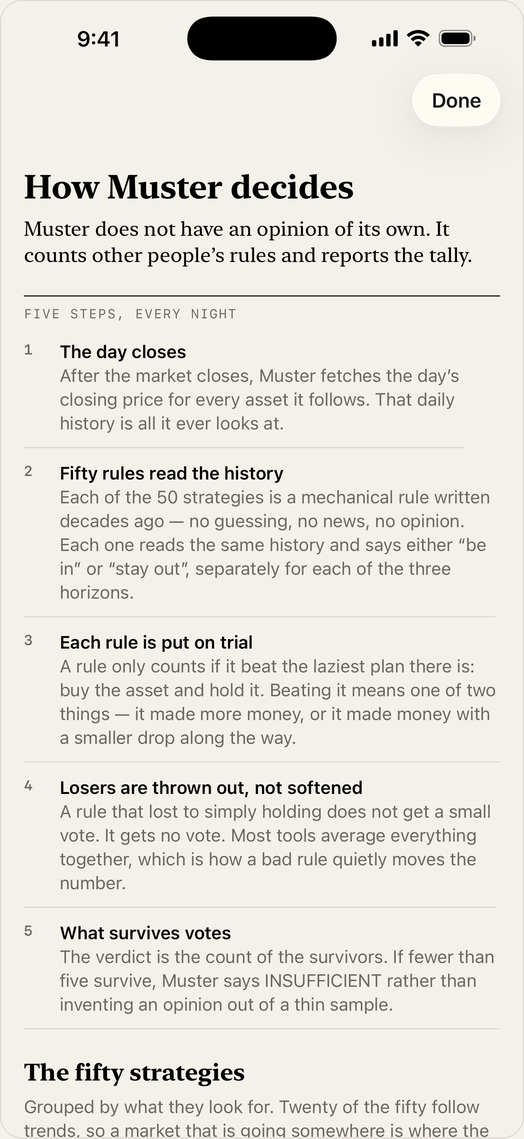
Muster tests first. Five steps, every night:
The day closes
Muster fetches the day's closing price for every asset it follows. That daily history is all it ever looks at.
Fifty rules read the history
Each strategy is mechanical, with no news and no judgment in it. Each one reads the same history and says either “be in” or “stay out”, separately for each of the three horizons.
Each rule goes on trial
A rule only counts if it beat the laziest plan available, which is buying the asset and holding it. Beating it means one of two things: it made more money, or it made money through a smaller fall along the way.
Losers are thrown out, not softened
A rule that lost to holding does not get a small vote. It gets no vote. Averaging everything together is how a bad rule quietly moves a number.
What survives votes
The verdict is the count of the survivors. Fewer than five survive and Muster reports INSUFFICIENT instead of inventing an opinion out of a thin sample.
How to read the count
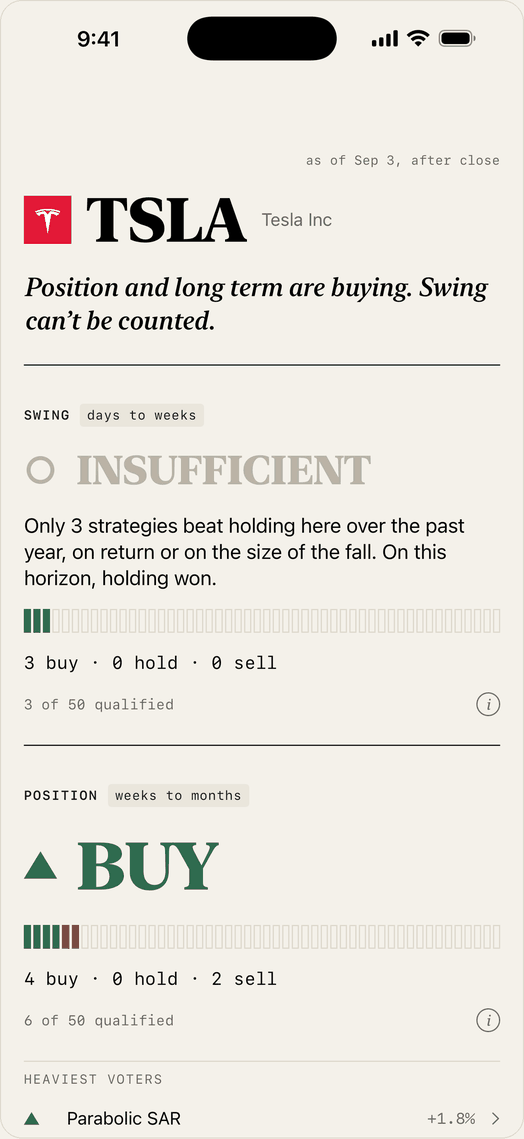
Each bar at the top of this page is one horizon of one asset. One mark per strategy, and the numbers underneath it.
On that asset's swing horizon, twenty-eight strategies beat holding over the last twelve months, so twenty-eight got a vote. The other twenty-two are the pale marks on the right, and they were thrown out. Of the twenty-eight, seventeen say stay out today, seven say be in, four are flat.
Each surviving strategy is weighted by how far it beat holding, so a rule that won by a nose does not outvote one that won by a mile.
Every verdict carries a shape, a colour and a word, so the screen still reads correctly if you cannot tell the green from the red.
the surviving strategies lean toward being in
they survived and they disagree, so there is no lean
they lean toward being out
fewer than five beat holding, so nothing is worth counting
Three horizons, read separately
A stock can be worth owning for five years and worth avoiding this month, and one rating cannot say both. Muster runs the same test three times over three windows and shows you all three at once.
Swing
Answers for days to weeks.
- Tested over
- 12 months
- Minimum
- 12 trades
Position
Answers for weeks to months.
- Tested over
- 24 months
- Minimum
- 4 trades
Long term
Answers for months to years.
- Tested over
- 5 years
- Minimum
- 2 trades
The minimum is the anti-luck rule. A strategy that fired twice in a year might have beaten holding by accident, so on the swing horizon it needs twelve closed trades before it is allowed to vote.
The line the app exists for
“Long term is buying what swing is selling.”
When the horizons disagree, the app says so in a sentence. Most tools average that split away and hand you a number that is true for nobody.
The screens
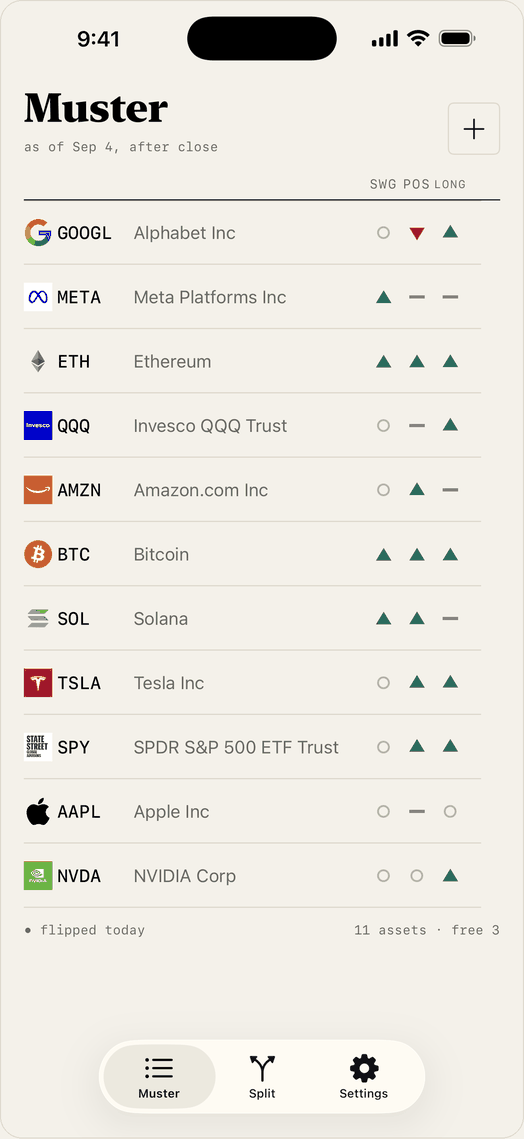
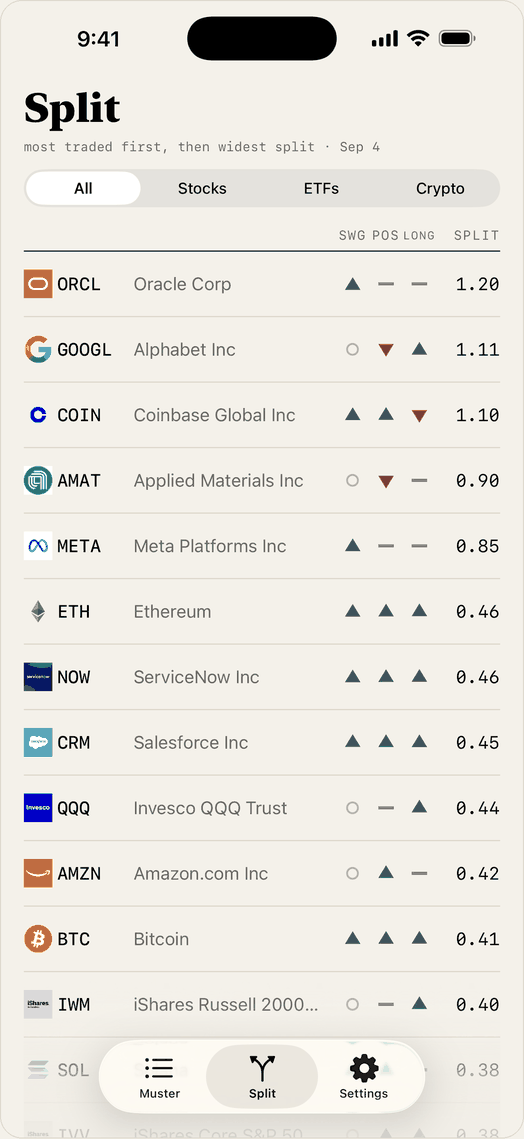
The honest state
When Muster has nothing to say, it says nothing
Holding an asset is a brutal benchmark over five years, and most mechanical rules lose to it. When fewer than five strategies clear that bar, the card reads INSUFFICIENT and explains itself: “Only 3 strategies beat holding here over the past year, on return or on the size of the fall. On this horizon, holding won.”
That state shows up often, and it is designed with the same care as the other three. An app that always has an opinion has none.
No charts, anywhere
No candles, no lines, no prices, no volume
Market data is licensed for you to look at, not for an app to redistribute, and a count of votes is not the price series. Muster publishes the count.
The side effect is that the app looks nothing like the wall of green and red everyone else ships, and it opens instantly.
Free and Pro
Free
Everything you need to read one asset
- 3 assets
- All three horizons on each
- The full method and strategy list
- Share cards
Muster Pro
The whole count, not just your three
- Split: the universe ranked by disagreement
- Unlimited watchlist
- Alerts when a horizon changes its verdict
- 90 days of history per asset
Monthly or yearly. The price in your currency is on the paywall before you buy, and you cancel in iPhone Settings.
Questions
Do I need to understand technical analysis?
No. You need to read one word and one bar. The strategy names are there if you want them, each with a two-sentence explanation written for someone who has never opened a chart, and you can ignore all of it and still use the app.
Does Muster tell me what to buy?
No, and it never uses the imperative. It reports how many mechanical rules, out of the ones that historically worked on that asset, currently lean which way. Nothing in the app says “time to sell”. It is a second opinion from fifty dead rules, not advice.
Where is the price chart?
There isn't one, by design. Showing market data to end users requires redistribution rights that cost orders of magnitude more than the data itself, so Muster publishes derived counts instead. No screen in the app shows a price, and no endpoint the app reads returns one.
Is it real time?
No. Everything runs on daily closing prices, once a night, and every screen carries an “as of” stamp so you always know how old the count is. Nothing here is built for intraday trading.
Which assets does it cover?
A curated list of large US stocks, the most traded ETFs, and major cryptocurrencies. A ticker needs enough daily history to backtest fifty strategies over three windows, so thin and recently listed names stay out. Ask for one at pevidios@proton.me and it may get added.
Why does an asset say INSUFFICIENT?
Fewer than five strategies beat holding it on that horizon, so there is no count worth reporting. Broad index funds hit this state regularly, which is the honest answer: on those, holding has been hard to beat.
Do I need an account?
No. No email, no password, no sign-in. On first launch the app generates a random identifier and keeps it in the Keychain, and that identifier is the only thing your watchlist is stored against. Settings › Delete local data destroys it. There is no analytics library and no ad identifier. The privacy policy is short.
How do the alerts behave?
They fire only when a verdict actually changes state, only on your assets, and only on the horizons you switch on. A swing asset can alert at most once a week, position once a fortnight, long term once a month, capped at five a day in total and never between nine at night and eight in the morning.
How do I cancel Pro?
iPhone Settings › your name › Subscriptions › Muster. Cancelling keeps Pro until the end of the period you already paid for. Refunds go through Apple at reportaproblem.apple.com.
Fifty strategies are already counted. Go read the tally.
Free · iPhone · iOS 27 or later
Muster counts how mechanical technical-analysis rules would have behaved on historical data. It is not investment advice, it is not a recommendation to buy or sell, and past performance does not predict future results. Pevide Studio LLC is not an investment adviser.